
In the Written Footsteps of Pierre Demers: Life and Correspondence, Matthieu Lavallée, Montreal, 2025. Self-published, available on Bouquinbec.ca or on Amazon.com.
September 29, 1939: “Tuesday, I saw Mr. Bruhat at the school. He has no doubt that I will be accepted into Joliot’s lab.”
May 19, 1940: “Yesterday I saw Mr. Joliot. He believes I already have half of my thesis.”
Quebecer Matthieu Lavallée was deeply influenced by the teaching of his physics professor, Pierre Demers (1914–2017), as well as by the memories Demers shared of his participation in historic nuclear research. After publishing Projet Manhattan: Montréal au cœur de la participation du Canada à la bombe atomique américaine with Antoine Théorêt, Lavallée has now made available the extensive correspondence that Pierre Demers sent to his parents between 1931 and 1961.
This near-weekly journal of a Quebec physicist—largely unknown in France—transcribed by Lavallée, is one of the rare “on-the-spot” accounts of the daily life of a young scientist in Paris at the end of the 1930s. A meticulous observer trained in the school of botanist Brother Marie-Victorin, founder of the French-Canadian Association for the Advancement of Science, Pierre Demers entered the École Normale Supérieure in October 1938. He obtained his agrégation in 1939. Writing in real time, he provides a precise schedule combining preparation for the agrégation, relocations of the physics laboratory, encounters typical of life at the ENS—including with the “Talas” (those who “von-T-à-la-messe”)—and holidays spent discovering France.
As the “Phoney War” had just begun, he joined Frédéric Joliot’s team, where we encounter lesser-known collaborators such as the Vietnamese Ngụy Như Kontum and the American Sherwood K. Haynes, who arrived on October 12 and left on May 26, 1940.
Little is known about the work assigned to him in this secret laboratory.
“Mr. Joliot proposed a very interesting subject to me… The experimental approach is somewhat disorienting: I am made to build boxes of cadmium, tinplate, or copper, which are filled with paraffin, boric acid, or various powders. I use a radioactive source consisting of three tubes, each containing 1/10 of a gram of radium, representing a total value of 300,000 francs. And I study the induced radioactivity in a sheet of gold… properly placed among these boxes and this radium.” Except that on May 18, “Mr. Joliot believes I already have half of my thesis.”
After the closure of the Atomic Synthesis Laboratory, Demers headed to Portugal, from where he returned to Canada. In 1943, he took part in the secret nuclear laboratory at the University of Montreal, where he rejoined part of Joliot’s team, particularly Halban, with whom he continued working. From 1946 onward, his letters—still addressed to his parents—were sent from the Chalk River Nuclear Laboratories, then from Montreal, when he became a physics professor at the university after defending his thesis in Paris in 1950. In 1958, he published Ionography: Nuclear Emulsions, Principles and Applications with the Presses de l’Université de Montréal.
Lavallée’s contribution is considerable in shedding light over nearly thirty years on the original researcher that Pierre Demers was, as well as on the world around him.
Indeed, events reach us without distortion. Pierre Demers himself was wary of memory, writing on June 10, 1940: “Mr. Joliot suggests that I leave Paris as soon as possible by my own means,” then recalling in 2008: “Joliot had given me written instructions.”
Lavallée is to be credited for providing readers with the scientific and institutional context on both sides of the Atlantic. It is unfortunate, however, that in his comparison of the radium institutes in Montreal and Paris, he does not take into account the available archives.
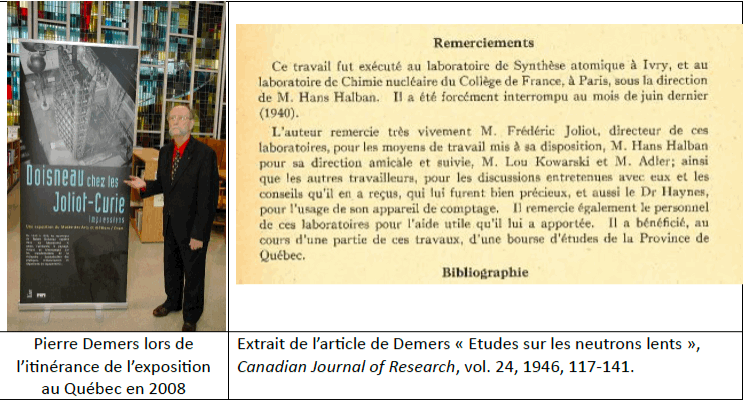
Two of the appendices deal with research conducted during the war. The discussion of the diary kept by Halban during the war, and of the “confidential” work carried out in Ivry as well as in Montreal, emphasizes Demers’s largely unrecognized contribution to this research. Lavallée cites the article “on slow neutrons,” written in France in 1940 but only published in Canada in 1946. It is regrettable that it is not included, as the reader would have found in it an echo of the work of Joliot’s doctoral student.
Founder of the International League of Scientists for the Use of the French Language, a polyglot by 1979, and passionate about botany, Pierre Demers was also a poet.
Ginette Gablot gigablot@gmail.com