The life of the association since its creation
Author: Monique Bordry
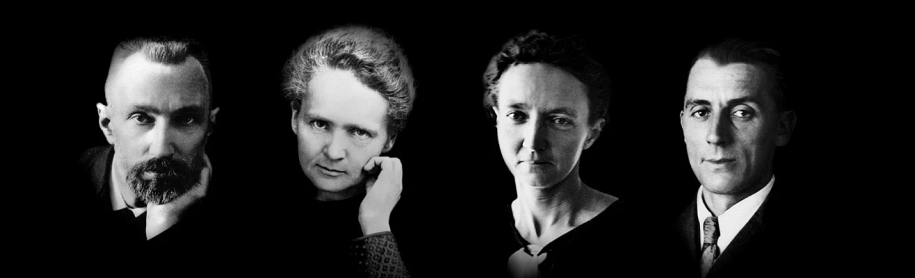
At the initiative of their former collaborators, family members, and friends, the Frédéric and Irène Joliot-Curie Association was founded on February 16, 1959, shortly after the death of Frédéric Joliot. Eugénie Cotton, former director of the École Supérieure des Jeunes Filles in Sèvres and former student of Marie Curie, became its first president. Pierre Biquard served as secretary general, and Roger Michaud as treasurer. The board included, among others, Hélène and Michel Langevin, Pierre and Anne Joliot, Georges Bouissières, Pierre Savel, Jean Teillac, and Roger Mayer.
From the very beginning, the Association gathered nearly 300 members, including family members, researchers, engineers, technicians, workers, and administrative staff, as well as political friends, both French and international, and all those interested in the lives and work of the Joliot-Curies.
Early on, the Joliot-Curie Association organized public lectures and exhibitions. Several members travelled throughout France to give talks.
During the International Congress of Nuclear Physics in July 1964, a ceremonial event at the Sorbonne marked the 30th anniversary of the discovery of artificial radioactivity. Members of the Association set up an exhibition room in the hall of the Radium Institute, displaying instruments used by the Curies and Joliot-Curies—particularly those for measuring natural radioactivity (ionization chamber, piezoelectric quartz, and quadrant electrometer). Two other display cases presented the Hoffmann electrometer used by Irène for her thesis and a Wilson chamber on which Frédéric Joliot had worked. Facsimiles of the Nobel Prizes and several photographs completed this small exhibition.
Later, members of the Association took part in numerous commemorations honoring the Curies and the Joliot-Curies. In November 1967, for instance, at the centenary of Marie Curie’s birth, Marcel Frilley and Paul Bonnet-Maury organized ceremonies at the Sorbonne. Around fifteen of Marie Curie’s former collaborators, French and foreign, shared their memories. The rue Pierre Curie was renamed rue Pierre et Marie Curie and inaugurated by Ève Curie.
At that time, the family made its first donation of Curie archives to the Bibliothèque Nationale (Ève Curie, Annie Angremy, Monique Bordry), followed by a second in 1974.
In 1972, the Association organized an exhibition on the Joliot-Curies in Bobigny, which later toured throughout France for over a year.
In 1981, the French League Against Cancer undertook the decontamination of a laboratory, making it accessible to the public.
Pierre Radvanyi succeeded Pierre Biquard as secretary general and proposed the creation of an educational kit on radioactivity for high schools.
Gradually, the public was allowed to visit the small museum room, as well as Marie Curie’s office and laboratory. Temporary student staff helped with guided tours. Marie-Thérèse Amrani from the Curie Institute joined the museum team, followed by Pierre Pindrus, Françoise Fayard, and Ginette Gablot from IN2P3.
From 1990 onwards, during the Science Festival, the Open Days at the Curie Institute attracted large audiences (600 visitors in 1990, 4,000 in 1998).
In 1997, the centenary of Irène Joliot-Curie’s birth was marked by a day of conferences on her life and work. In 2000, the centenary of Frédéric Joliot’s birth was commemorated with a series of talks at the Collège de France.
It is difficult to clearly separate the activities of the Association from those of the Joint Service Unit “Museum and Archives of the Radium Institute”, created in 1994, which I was entrusted to direct.
The transfer of Pierre and Marie Curie’s ashes to the Panthéon in April 1995 drew considerable public attention.
The archives kept at the Museum have been increasingly consulted by writers, journalists, and students. The photo collection is in high demand, and researchers regularly visit the historical library.
The old instruments from the Curie Laboratory have been catalogued and described in detail.
To close the centenary of the discovery of natural radioactivity, the museum team (Monique Bordry, Soraya Boudia) presented the exhibition “Les Rayons de la Vie” (The Rays of Life) at the Galerie de Minéralogie of the Muséum National d’Histoire Naturelle, from September 1998 to April 1999.
The presidents of the Association have been: Eugénie Cotton, Jean Teillac, Pierre-Gilles de Gennes, Hubert Curien, Édouard Brézin, and currently Michel Spiro.
The secretaries general have been: Pierre Biquard, Pierre Radvanyi, and currently Dominique Guillemaud Mueller.
The museum directors have successively been: Monique Bordry, M. X, Soraya Boudia, Renaud Huynh, and currently Denis Guthleben.